Wednesday, 6 March 2013

graphical design + INFORMATION =

Infographics combine data with design to enable visual learning. This communication process helps deliver complex information in a way that is more quickly and easily understood - Mark Smiciklas
Beautiful too look upon, robust in their ability to express large amounts of data or complex ideas in a series of images or a single picture, infographics are without a doubt one of the more interesting applications of web-based software that were traditionally the domain of mad men-esque advertisers.

Here is a great example of an infographic, which (created by the Huffington Postusefully is about infographics -  -  -  ->

While the 'idea' of representing information visually is certainly not a new concept, the use of technology through websites - like infogr.am, visual.ly, and piktochart.com  - have greatly placed the ability to create these type of documents at the fingertips of the average web user.

Which means that even the most graphically or statistically incapable teacher (or student!) might be able to throw together some eye-catching visuals to augment what might have been another text or data heavy presentation.

As we know from 'Success for all Learners', differentiating our instruction in order to meet the individual learning needs of our students is an important part of lesson planning for today's teachers. By utilizing graphical designs to meet the needs of our visual-spatial learners, infographics may be used in support of a teachers pedagogy - if used properly.

I was able to create my first infographic to use in a presentation for another course, using StatsCan data to give a Canadian perspective to the content we were discussing from our American text book. The only difficult issue I encountered was adding the visual to a PowerPoint document, as infogr.am is primarily meant for sharing in web-based contexts (like this!). 

Please click and explore:


Monday, 4 March 2013

I have little [digital] feet apparently

According to UrbanDictionary.com, a 'Nick Baron' is:

A troll commonly found riddling people around and abouts the Hillsborough county area in Florida.

Which I thought was odd, mainly because I've never once riddled anyone around Hillsborough County.

... And so began my search into my digital footprint. Googling my name returned nothing of interest in the top 10 links; aside from the definition (above) and use-in-a-sentence (below).

That bouncer just riddled me to get in the bar, must be a nick baron.

Awesomely, the top rated item from Bing.com was for Special Agent Nick Baron's (no relation) investigation into the 'Dimitron Duo', who were wanted by the FBI on fraud charges. However, neither Bing or Yahoo.com returned any valid results within the first 50 items. In fact, it wasn't until the thirtieth item that this blog showed up in Google, representing my first footprint in the digital world.

Interestingly, a person-specific search engine called ZoomInfo did actually return one valid result: my employee profile from when I interned for multinational Enterprise Rent-A-Car. So with such few results, I took a page out of Mr. Affleck's blog on his digital footprint, and combined my location (Brandon) with my name.

While adding the address did not change the ZoomInfo results in any significant way, it did have an immediate impact on the traditional search engines, with the top four Google links actually being me!

Surprisingly, none of my twitter, Facebook or social media content came up - in fact the only information that I could find was related to the blogging we have done for this course, and my participation as a karate instructor.

What little feet I have.

today's connected student

So I've been struggling with what todays connected student looks like: from reports of Facebook membership evaporating among teens, to rumours of anonymous messaging apps... Am I really already 'not with it'?

So instead of guessing, I've tried to do some research on the 21st Century Connected Student:

From the Pew Research Center, we get info on what devices they are using -  -  -  -->

A quick search of wikipedia gives us some of the most popular social networking websites in North America:
facebook, fourSquare, skype, Google+, pinterest, snapChat, flickr, imgur, youtube, blogspot, blogger, netflix, reddit, instagram...

And an app search reveals: kik messenger, tumblr, vine, Voxer (walkie-talkie), wordpress...

While these are all access points/tools to communicating with one another, they really give no hint to the amount that students use them - that is how popular Instagram is over Facebook among adolescent users. A recent article published by the San Francisco Chronicle highlights Facebooks waning popularity with youngsters, and hints that they're looking for different, more private ways of connecting than 'big brother'-esque Facebook.
Interestingly, and I attribute this largely to a generational divide, but I have seen few 'connected students' posts that consider gaming consoles and their attached online communities (like XboxLive) that surround particular games (like the infamous Call of Duty series of first-person shooters). Personal computers still satisfy groups of players on MMORPGs, which constitute an entire different form of social-networking where individuals are encouraged to create an online persona that differs from their away-from-the-keyboard identity. 

So it's with some forethought that I present my 'Connected Student' diagram:


Sunday, 24 February 2013

on blogging, commenting, tweeting, searching, curating... and comprehending

Dear classmates of Prof. Mike Nantais 'Internet for Educators', 

With class time last week being designated as group-project work and an informal sharing session, it allowed me time to reflect on the past weeks: on the speakers who've taken the time to share with us, on the different tools each of us use, the impact those instruments and ideas may have on my future classroom, and the responses from you - my fellow classmates - on all of these ideas.

First, how do you all stay up on reading everyone's blogs? I've attempted to use a Chrome extension called 'SpeakIt!' which converts website text into audio via the voice of your choice: English Canadian Male speaker or Hong Kong Cantonese Female or ..., &c. While I really like 'hearing' what you have to say - the app still requires that I select each individual bits of text, which  unfortunately is time consuming and undermines the real reason for attempting to use it in the first place. I've put the question to twitter to see what you all have to say:
In the same vein, I've constantly ran into a little bug where I'm unable to comment on your  blogs because my profile is not signed in - despite accessing your respective blogs from Google Reader and repeatedly clicking sign in. Which brings me to a bit of a techno-wish: why can I share your writings on Twitter, facebook, Google+; but I can't comment within Reader?  

Todays' a rant day dear readers: please place your rants below!

Edit: I'd also like to share with you my (current) go to site for new music: 

indiecurrent.com


leading the student ... to web based courses


Not a speaker phone, but similar
Throughout my academic history I've taken four distance courses for various reasons. In high school, I was considering applying to university in Ontario around the same time that that province was phasing out OAC. In order to increase my chance of being accepted, I took a paper-based course in Calculus that was centered around a speaker-phone call once a week in the schools library.

Later during my undergrad I was unable to fit a required course into my schedule, but was quite thankful that a distance course was an option. Finally last fall, after finding out that one of my teachables was no longer accepted at Brandon University, I was able to meet the Education Faculties requirements for a second teachable via two web-based courses at the University of Manitoba as a visiting student. 

In each of these courses, I had a need for a course credit, but was unable to wait or travel to a regular classroom. So in that sense Distance Learning was a great fit for me and satisfied the prerequisites I needed... 

However, I have learned that I do not perform very well in a distance learning environment. While I obtained passing grades on all of these courses, even today I'm struggling to recall anything particularly relevant.

So it is with some experience in distance learning that we listened in on Sophia & Donald's presentation on their work with the Distance Learning unit from Manitoba Education. As a preservice teacher, knowing that their are optional courses out there for my future students and course resources for myself, is a true benefit. Additionally, as Prof. Mike Nantais was keen to point out, the BlackBoard webware provides an alternative to public blogging and internet usage that some conservative communities may be unease with. 

One of the more interesting statements from the presenters was Sophia's emphasis on pedagogy first, rather than focusing on creating a course because the tools are there. Thinking of the students learning needs, including whether a distance course fits an individual students learning style, should be at the forefront of every teachers mind. From my own experiences it is clear to me that there is a demand for distance learning, but I wonder that if some differentiation had been built into the course content that the (and my own) outcomes could be greatly improved. 

Tuesday, 12 February 2013

on Clarence Fisher: connecting students to the wide world

So far we have had principals, government officials, and industry consultants speak to us, but Mr. Fisher, is our first Teacher. First practicing teacher that is: Clarence Fisher teaches a split grade 7/8 class up in Swan Lake, Manitoba, and was also the first speaker to truly talk about using technology and the internet to benefit the students in his remote classroom.
Fisher touched on the changing mobility of education, from the inclusion of students own iPods, laptops and tablets, and debated the authenticity of students blogging and posting pictures in the classroom. His most influential comments (to me) were about using that technology to gain perspective, to introduce his students (who are nearly 700 km North of Winnipeg) to global communities. 

Clarence referred to this as expanding their 'network of learners':
'if kids are only exposed to the same kids in your class, then that's it. But the larger the network the better - no longer is any kid, or even myself, the oldest/smartest person in the room - and that fundamentally changes things' - Clarence Fisher, February 7/2013.
Which he did by taking an old idea - pen pals - and giving it a moden turn: Clarence connected his students with classes in Colombia, Peru, Los Angeles, and Malaysia through like-minded teachers through the internet. By doing so, he was able to give his small town classroom an international presence and open his students up to cultures, ideas and concepts that they otherwise would likely of never had.

What Clarence has noticed about this expansion of his students learning network, is that they have become engaged. He has noticed them working at home with students from another country on group activities, assisting each other with homework; essentially learning based on their own inquiry. By sharing through their youTube account, posting pictures to Flikr, his students have found new ways to represent and view the world that wasn't possible a generation ago.


At this time, Clarence is experimenting with computer coding in the classroom, exposing his students to AutoCAD, animation/video making and exciting new developments like 3D-printing in a bid to keep his classroom within the authentic real world. To me, Clarence's class is real world inspiration of how a teacher can be effective wherever they are in the world today, and that if an educator has the humility to let others into their classroom, it can make a world of difference. 


Tuesday, 5 February 2013

anti-awards, anti-grades with George Couros

http://georgecouros.ca
Last Thursday we had the great opportunity to Skype with Mr. George Couros, Division Principal of Innovative Teaching and Learning for Alberta PSD70. While John Finch spoke to us about 'big-picture' topics like copyright law and public policy earlier in the week, George took a pragmatic approach throughout his presentation. He offered advice on making a digital vs analog impact with professional portfolios, discussed the differences between a holistic 'school' teacher vs the isolated classroom teacher, and offered sage words on contacting parents while being angry with their kid.

However, the most powerful message I received was his thoughts and experiences with removing grades and awards from his school. George stated this as the difference between performance goals and learning goals. Performance goals are the checkmarks, the conditioning, the "if you sit, I will give you a bone" type of summative assessments; whereas learning goals can encompass the broader, more inquiry-based goals of "I want to speak fluid french". 


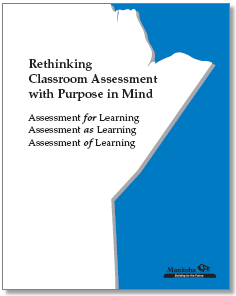
While the concepts of formative versus summative assessment are not new to us, and have been advocated heavily for by professionals like Brian Cox (Real World Teaching) and MB Education (Rethinking classroom assessment with purpose in mind), they have been theoretical or isolated to a single classroom. George's experiences, however, extend to an entire school where they removed both awards and grades.

After class I tweeted George about this school, as I was unaware that such a school existed within the public system in Canada. He directed me to an archived blog post of his about the subject (here), where he discussed the cons of the traditional system and the advantages of moving towards solely formative assessment.

I'm all for this, but as someone who graduated with grades, received awards and values my GPA - in short someone conditioned to succeed with grades - I question how students, who like me, adapt to a system without rewards? What sort of outcomes do students have within this revolutionary system? As with John Finch's argument for data over intuition, are we able to give a grade to anti-grade systems? After all, as George stated:
"We are measured as a teacher by what they do after, rather than what they do in class".